RBI’s Role in India’s Financial System
The Day Aarav Realised One Institution Quietly Shapes His Financial Life
One morning, Aarav checked his banking app and noticed that his home loan interest rate had changed. Later that day, he read a news headline about inflation easing, while another article mentioned new rules for digital payments and banking security. Curious, he asked himself, “Who makes these decisions that affect my savings, loans, investments, and even the way I pay for my morning coffee?”
As he explored further, Aarav discovered that many of these changes were influenced by one institution—the Reserve Bank of India (RBI). Although most people never interact with the RBI directly, its policies shape nearly every aspect of India’s financial system. From controlling inflation and regulating banks to ensuring secure digital payments and maintaining financial stability, the RBI plays a critical role in keeping the Indian economy functioning smoothly.
Understanding the RBI isn’t just important for economists—it helps every individual make better financial decisions and understand why interest rates, banking regulations, and economic conditions change over time.

What Is the Reserve Bank of India (RBI)?
The Reserve Bank of India (RBI) is India’s central bank. Established on 1 April 1935 under the Reserve Bank of India Act, 1934, it became a nationalised institution in 1949.
Unlike commercial banks, which provide banking services directly to customers, the RBI supervises and regulates the country’s banking and financial system while maintaining monetary and financial stability.
The RBI’s primary responsibilities include:
- Formulating and implementing monetary policy.
- Maintaining price stability while supporting economic growth.
- Regulating banks and financial institutions.
- Managing India’s foreign exchange reserves.
- Issuing currency notes.
- Supervising payment and settlement systems.
- Promoting financial inclusion.
- Maintaining public confidence in the financial system.
Why the RBI Matters
The RBI influences almost every aspect of India’s economy.
Whether you:
- Save money in a bank,
- Apply for a home loan,
- Use UPI for digital payments,
- Invest in government securities,
- Exchange foreign currency, or
- Borrow through a credit card,
the RBI’s regulations and policies help create a secure, stable, and efficient financial environment.
What the Research and Statistics Show
Several official sources demonstrate the RBI’s central role in India’s financial system:
- According to the Reserve Bank of India (RBI) Annual Report 2024–25, India’s financial system has continued to strengthen through improvements in banking resilience, payment infrastructure, financial inclusion, and digital innovation.
- The National Payments Corporation of India (NPCI) reports that UPI processes billions of transactions every month, making India one of the world’s largest real-time digital payment ecosystems.
- According to the World Bank’s Global Findex Database 2021, 78% of adults in India had an account with a formal financial institution or mobile money provider, a significant increase over the previous decade, reflecting expanding financial inclusion.
These developments illustrate how the RBI’s policies support economic growth, banking stability, and wider access to financial services.
The Key Functions of the RBI
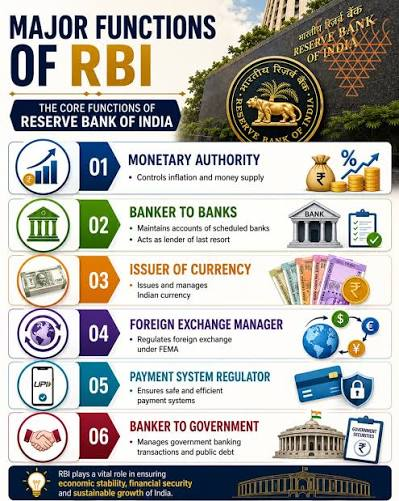
1. Formulating Monetary Policy
One of the RBI’s most important responsibilities is managing monetary policy, which influences the amount of money circulating in the economy.
Its objectives include:
- Maintaining price stability.
- Supporting sustainable economic growth.
- Controlling inflation.
- Ensuring adequate liquidity in the financial system.
The RBI’s Monetary Policy Committee (MPC) reviews economic conditions regularly and determines the policy repo rate.
2. Regulating Banks
The RBI licenses, supervises, and regulates commercial banks, cooperative banks, small finance banks, and certain non-banking financial institutions.
Its responsibilities include:
- Setting prudential regulations.
- Monitoring financial health.
- Conducting inspections.
- Promoting responsible lending.
- Protecting depositors.
- Ensuring compliance with banking laws.
This supervision helps maintain confidence in India’s banking system.
3. Issuing Currency
The RBI has the responsibility for issuing most banknotes in India and managing the country’s currency supply.
It ensures:
- Adequate availability of currency.
- High-quality banknotes.
- Counterfeit prevention measures.
- Efficient circulation of cash.
This function supports smooth day-to-day economic activity.
4. Managing Inflation
Inflation affects the purchasing power of every household.
The RBI uses monetary policy tools to help keep inflation within its target framework while supporting sustainable economic growth.
Stable inflation benefits consumers, businesses, and investors by improving economic predictability.
5. Managing Foreign Exchange Reserves
India’s foreign exchange reserves help strengthen confidence in the country’s economy.
The RBI manages these reserves to:
- Maintain external stability.
- Support international trade.
- Reduce exchange rate volatility.
- Strengthen investor confidence.
6. Supervising Payment Systems
India’s digital payments ecosystem has expanded rapidly.
The RBI regulates and oversees payment systems including:
- UPI
- NEFT
- RTGS
- IMPS
- Card payment networks
- Prepaid payment instruments
Its oversight helps improve efficiency, reliability, and security.
7. Promoting Financial Inclusion
The RBI works alongside banks, regulators, and the Government of India to improve access to formal financial services.
Financial inclusion initiatives support:
- Rural banking.
- Small businesses.
- Women entrepreneurs.
- Digital banking adoption.
- Financial literacy.
- Affordable banking services.
Greater financial inclusion contributes to economic development and social wellbeing.
How RBI Policies Affect Your Daily Life
Many people assume the RBI only influences banks, but its decisions affect everyday finances in several ways.
Interest Rates
Changes in the policy repo rate can influence:
- Home loan rates.
- Personal loan rates.
- Business loan costs.
- Fixed Deposit interest rates.
- Savings rates.
Inflation
RBI policies help maintain purchasing power by working to keep inflation under control over the medium term.
Digital Banking
The RBI establishes regulations that support secure digital payments and protect consumers using online banking and payment platforms.
Financial Stability
Strong banking supervision reduces systemic risks and helps maintain confidence in financial institutions.
Common Misconceptions About the RBI
“The RBI Is Just Another Bank”
The RBI is India’s central bank and does not operate like a commercial bank serving the general public.
“The RBI Sets Every Bank Interest Rate”
The RBI influences borrowing costs through monetary policy, but commercial banks determine many lending and deposit rates based on market conditions and their own policies.
“The RBI Controls Stock Market Prices”
The RBI influences overall economic conditions, but stock prices are primarily driven by corporate performance, investor sentiment, economic expectations, and market forces.
“The RBI Only Prints Money”
Currency issuance is only one of many responsibilities. Monetary policy, financial regulation, payment systems, and financial stability are equally important parts of its mandate.
Why Understanding the RBI Helps You Make Better Financial Decisions
Understanding the RBI can help you:
- Interpret changes in loan interest rates.
- Understand inflation and its impact.
- Make better saving and borrowing decisions.
- Follow economic news with greater confidence.
- Understand banking regulations.
- Appreciate the importance of financial stability.
Financial literacy begins with understanding the institutions that influence your money.
How Our Blog Helps You Build Financial Knowledge
Finance can often seem complicated because economic news is filled with technical language and unfamiliar concepts. Our blog simplifies these topics through practical, evidence-based explanations that anyone can understand.
By following our articles, you’ll learn how to:
- Understand RBI policies and monetary decisions.
- Compare banking and investment products.
- Improve budgeting and saving habits.
- Understand inflation and interest rates.
- Build stronger financial literacy.
- Stay informed about digital banking and financial technology.
- Make confident financial decisions based on trusted information.
- Achieve your long-term financial goals with greater clarity.
Our mission is to transform complex financial concepts into practical knowledge that helps readers make smarter money decisions every day.
A Strong Financial System Benefits Everyone
The RBI may operate behind the scenes, but its decisions influence nearly every aspect of India’s financial landscape. By maintaining monetary stability, supervising financial institutions, strengthening digital payment systems, and promoting financial inclusion, the RBI creates an environment where households, businesses, and investors can plan with greater confidence. Understanding its role empowers individuals to interpret economic developments more effectively and make informed financial choices throughout their lives.
Conclusion
The Reserve Bank of India is far more than the country’s central bank—it is the foundation of India’s financial stability, responsible for managing monetary policy, regulating banks, overseeing payment systems, controlling inflation, and supporting sustainable economic growth. Its decisions influence everything from home loan interest rates and savings returns to digital payments and financial security. By understanding the RBI’s role, you can better navigate changes in the economy and make informed financial decisions that support your long-term goals. Our blog is committed to helping you simplify complex financial topics through trusted insights, practical guidance, and evidence-based education, so now that you know how the RBI shapes India’s financial system, how will you use that knowledge to make smarter financial decisions?
- Reserve Bank of India (RBI). Annual Report 2024–25: https://www.rbi.org.in/
- National Payments Corporation of India (NPCI). UPI Product Statistics: https://www.npci.org.in/what-we-do/upi/product-statistics
- World Bank. Global Findex Database 2021: https://www.worldbank.org/en/publication/globalfindex