
How Banks Make Money: A Simple Explanation
The Question That Changed Ethan’s View of Banking
Every month, Ethan received his salary into his bank account, paid his bills through mobile banking, used his debit card for shopping, and occasionally applied for a loan when he needed extra funds. One day, while reviewing his bank statement, he wondered, “If banks offer free mobile apps, reward programmes, ATMs, and customer support, how do they actually make money?”
Like many people, Ethan assumed banks simply kept customers’ money safe. However, after learning more about how the banking system works, he discovered that banks are sophisticated financial institutions that generate income through lending, investments, fees, and other financial services. Understanding this not only answered his curiosity but also helped him make smarter decisions about savings accounts, loans, credit cards, and banking products.
If you’ve ever wondered how banks operate behind the scenes, this guide explains the process in simple terms.
What Is a Bank?
A bank is a licensed financial institution that accepts deposits from customers and uses those funds to provide loans and other financial services. Banks play a vital role in the economy by connecting savers with borrowers, facilitating payments, supporting businesses, and promoting economic growth.
Most commercial banks provide services such as:
- Savings and current accounts
- Personal and business loans
- Mortgages
- Credit cards
- Digital banking
- Foreign exchange services
- Investment and wealth management
- Payment processing
While these services benefit customers, they also generate revenue that allows banks to operate profitably.
Why Banks Are Important to the Economy
Banks do much more than hold money. They support individuals, businesses, and governments by ensuring money flows efficiently through the economy.
According to respected international organisations:
- The World Bank notes that well-functioning financial systems help reduce poverty, encourage investment, support entrepreneurship, and promote sustainable economic growth.
- The Bank for International Settlements (BIS) explains that banks play a central role in allocating capital, managing liquidity, and maintaining financial stability.
- According to the International Monetary Fund (IMF), a healthy banking system is essential for supporting economic activity because it channels savings into productive investment.
These organisations highlight why understanding banking is important for anyone interested in personal finance.
The Main Ways Banks Make Money
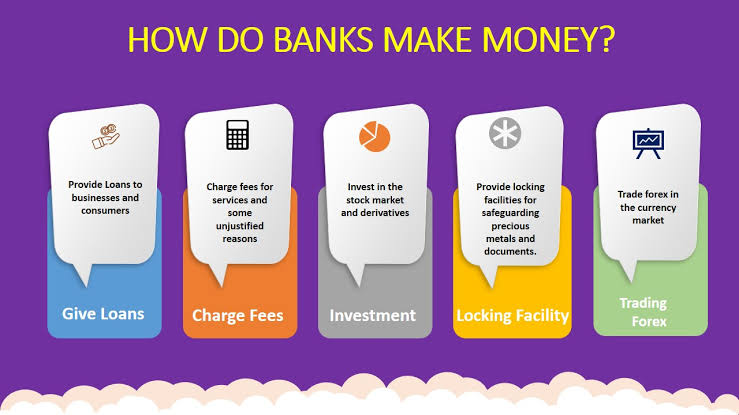
1. Interest on Loans
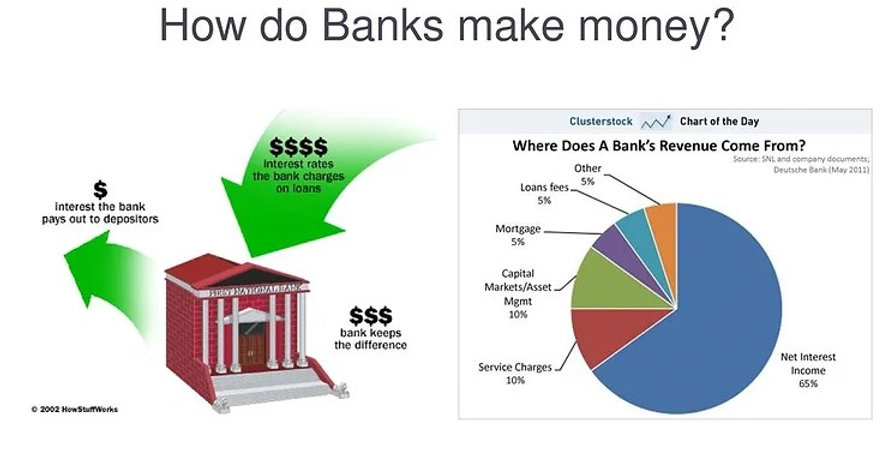
The largest source of income for most commercial banks comes from lending money.
When customers deposit money into savings accounts, banks do not simply store those funds in a vault. Instead, they use a portion of those deposits to provide loans to individuals and businesses while maintaining reserves and meeting regulatory requirements.
For example:
- A customer deposits money into a savings account.
- The bank pays the customer a modest rate of interest.
- The bank lends part of those funds to borrowers at a higher interest rate.
- The difference between the interest earned and the interest paid is known as the net interest margin, which is a major source of bank income.
This lending model forms the foundation of traditional banking.
2. Loan Processing and Service Fees
Banks also earn money through various fees associated with financial products and services, including:
- Loan processing fees
- Mortgage arrangement fees
- Credit card annual fees
- Foreign transaction fees
- Overdraft charges
- Account maintenance fees (where applicable)
- Safe deposit box fees
Many banks have reduced or eliminated certain fees because of competition and digital banking, but service charges remain an important source of revenue.
3. Credit Card Income
Credit cards generate revenue for banks in several ways.
Banks may earn income from:
- Interest charged on outstanding balances
- Annual membership fees
- Merchant interchange fees
- Late payment charges
- Foreign currency conversion fees
Customers who repay their balance in full each month often avoid interest charges, making responsible credit card use beneficial for both budgeting and maintaining a healthy credit history.
4. Investment Activities
Banks invest a portion of their capital in relatively low-risk financial assets, including:
- Government securities
- Corporate bonds
- Money market instruments
- Other approved investments
These investments generate additional income while helping banks manage liquidity and regulatory requirements.
5. Payment Processing Services
Every day, banks process millions of financial transactions.
They facilitate:
- Debit card payments
- Credit card payments
- Online banking transfers
- Mobile banking transactions
- International money transfers
- Merchant payment services
Businesses often pay fees for payment processing, creating another important income stream for banks.
6. Wealth Management and Advisory Services
Many banks offer financial planning and investment services to individuals and businesses.
These services may include:
- Investment advice
- Retirement planning
- Portfolio management
- Insurance products
- Estate planning
- Corporate financial advisory
Banks typically earn management or advisory fees for providing these specialised services.
How Banks Balance Risk and Profit
Lending money always involves risk because borrowers may fail to repay their loans. Banks therefore use detailed credit assessments, affordability checks, and risk management systems before approving credit.
They also diversify their lending across different customer groups, industries, and loan types to reduce exposure to any single source of risk. In addition, regulators require banks to maintain capital buffers and liquidity to improve resilience during periods of economic uncertainty.
Balancing profitability with prudent risk management is one of the most important responsibilities of a modern bank.
Common Misunderstandings About Banks
Many people have misconceptions about how banks operate. Here are a few examples:
“Banks Keep All Deposits in Their Vaults”
In reality, banks use customer deposits to support lending and investment activities while maintaining required reserves and liquidity.
“Banks Only Make Money from Loan Interest”
Although lending is a major income source, banks also earn revenue from payment services, investments, wealth management, and service fees.
“Digital Banking Is Free for Banks”
While many digital banking services are free for customers, banks invest heavily in technology infrastructure, cybersecurity, fraud prevention, regulatory compliance, and customer support.
“Banks Cannot Lose Money”
Banks face risks including loan defaults, market volatility, cybersecurity threats, operational failures, and changing economic conditions, making effective risk management essential.
How Understanding Banking Helps You Make Better Financial Decisions
Knowing how banks generate income can help you become a more informed consumer by enabling you to:
- Compare savings and loan products more effectively.
- Understand why interest rates differ.
- Recognise the impact of fees and charges.
- Use credit responsibly.
- Choose suitable banking products.
- Improve your overall financial literacy.
An informed customer is often better equipped to make sound financial decisions.
How Our Blog Helps You Achieve Your Financial Goals
Financial products and banking services can seem complicated, particularly for those beginning their personal finance journey. Our blog is dedicated to explaining financial concepts in clear, practical language supported by trusted research and real-world examples.
By following our articles, you’ll learn how to:
- Understand how banks and financial institutions operate.
- Compare loans, savings accounts, and investment products.
- Improve budgeting and money management.
- Build healthy credit habits.
- Stay informed about digital banking and financial technology.
- Avoid common financial mistakes.
- Strengthen your financial literacy.
- Make confident decisions that support your long-term financial goals.
Our mission is to simplify personal finance so readers can make informed choices with greater confidence.
Knowledge Is One of Your Greatest Financial Assets
The more you understand how banks operate, the easier it becomes to evaluate financial products, avoid unnecessary costs, and use banking services to your advantage. Rather than viewing banks simply as places to store money, understanding their business model allows you to become a smarter saver, borrower, and investor. Financial knowledge empowers you to ask better questions, compare products more effectively, and make decisions that support lasting financial success.
Conclusion
Banks are the foundation of the modern financial system, generating income through lending, payment processing, investments, advisory services, and carefully managed fees while supporting economic growth and financial stability. Understanding how banks make money not only satisfies curiosity but also helps you choose better financial products, manage borrowing responsibly, and improve your overall financial wellbeing. Our blog is committed to helping you navigate the world of banking and personal finance with trusted insights, practical guidance, and evidence-based education, so now that you know how banks make money, are you ready to make your money work harder for you?
- World Bank. Financial Sector Overview: https://www.worldbank.org/en/topic/financialsector
- Bank for International Settlements (BIS). About BIS and publications on banking and financial stability: https://www.bis.org/
- International Monetary Fund (IMF). Financial Stability: https://www.imf.org/en/Topics/financial-sector